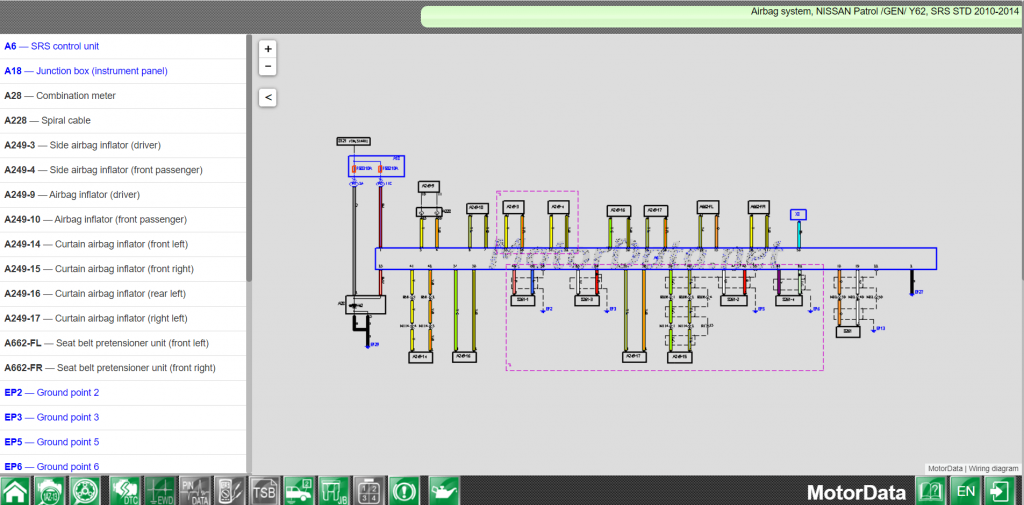
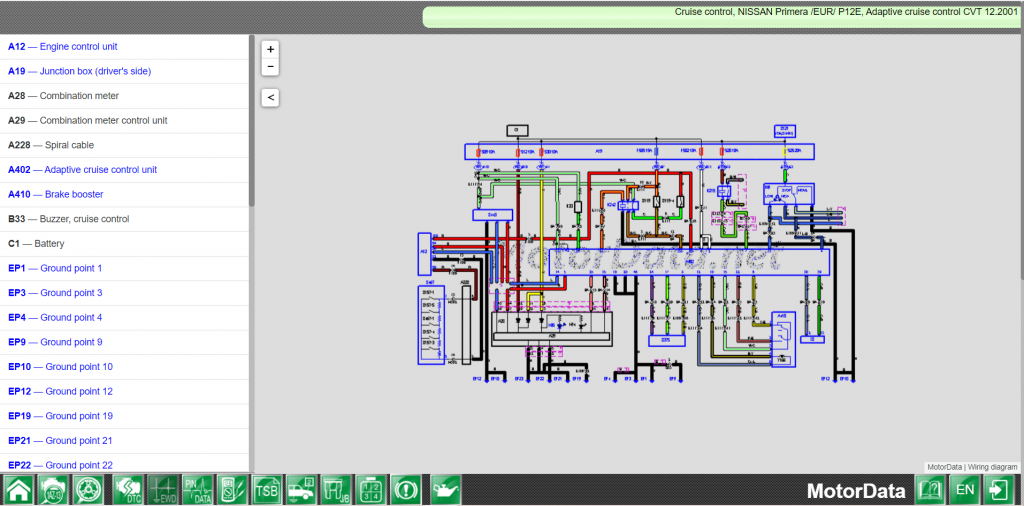
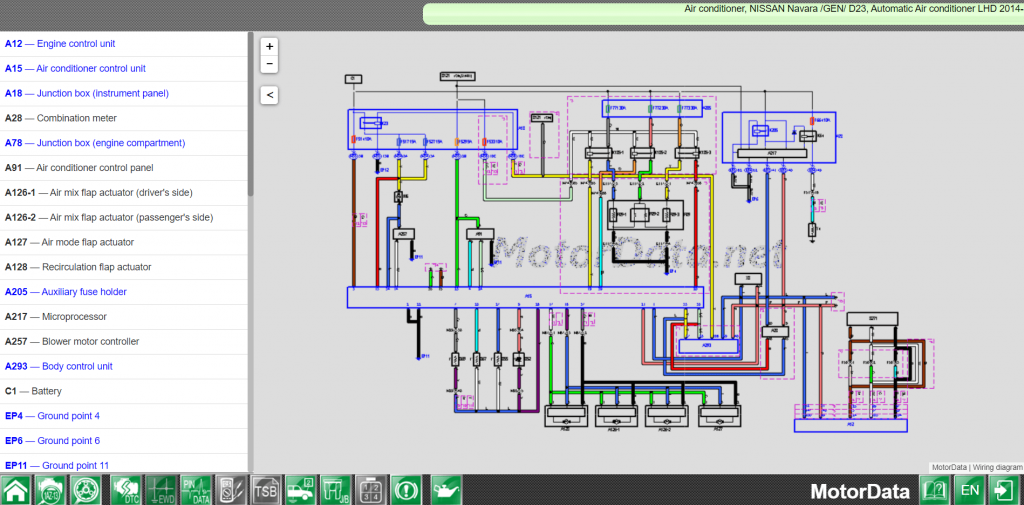
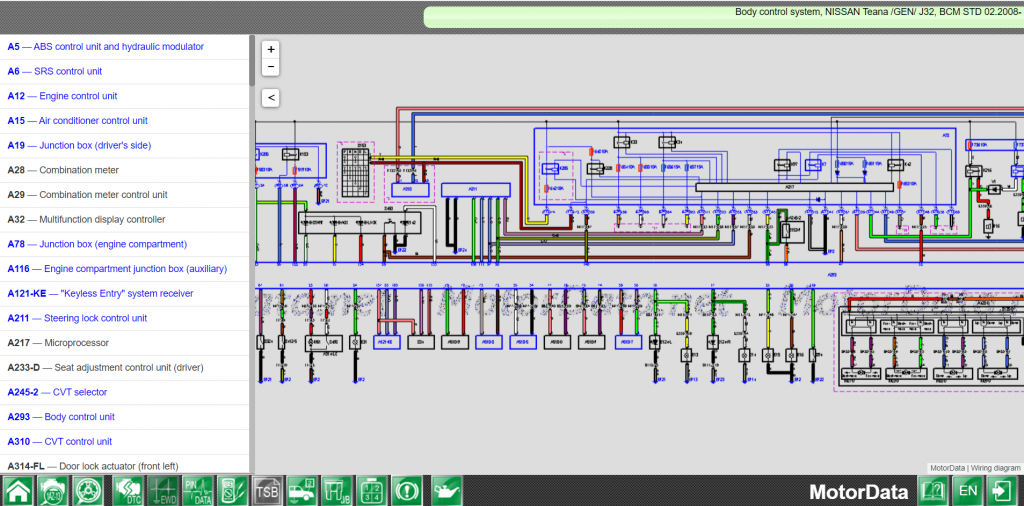
MotorData Professional gives auto electricians and diagnostic technicians instant online access to interactive color wiring diagrams for
Nissan vehicles — Qashqai, X-Trail, Almera, Terrano, Murano, Pathfinder, Navara, Sentra, Teana, Micra, Note, Juke, Tiida, Primera and over 170 Nissan models from 1986 to 2022.
The MotorData database contains more than 20,000 interactive color wiring diagrams covering 600+ vehicle models from Japan, Korea, China and Europe — with an extensive dedicated collection for Nissan and Infiniti. All diagrams are cloud-based and accessible from any device without installation.
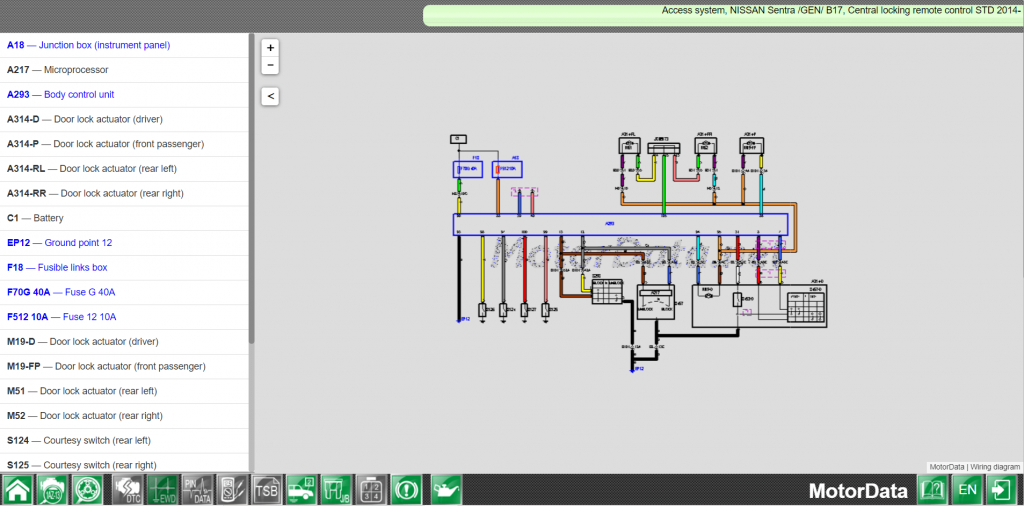
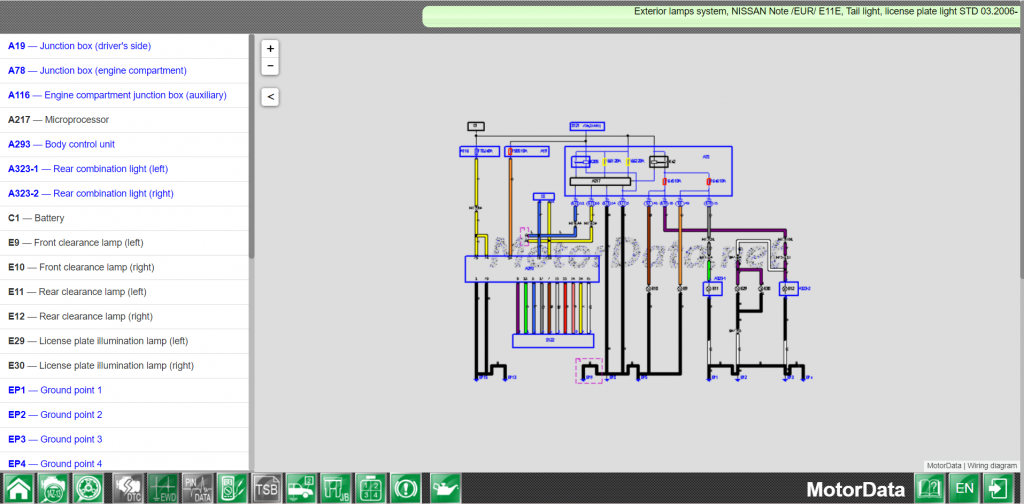
Every Nissan wiring diagram is fully color-coded (matching actual vehicle wire colors), zoomable and fully clickable: select any wire to trace its entire path through the circuit, zoom into connector details, and jump directly to the related DTC code, ECU pinout, fuse/relay data or TSB bulletin — all within one platform. Unlike static PDF manuals, MotorData diagrams are fully interactive and cross-referenced.

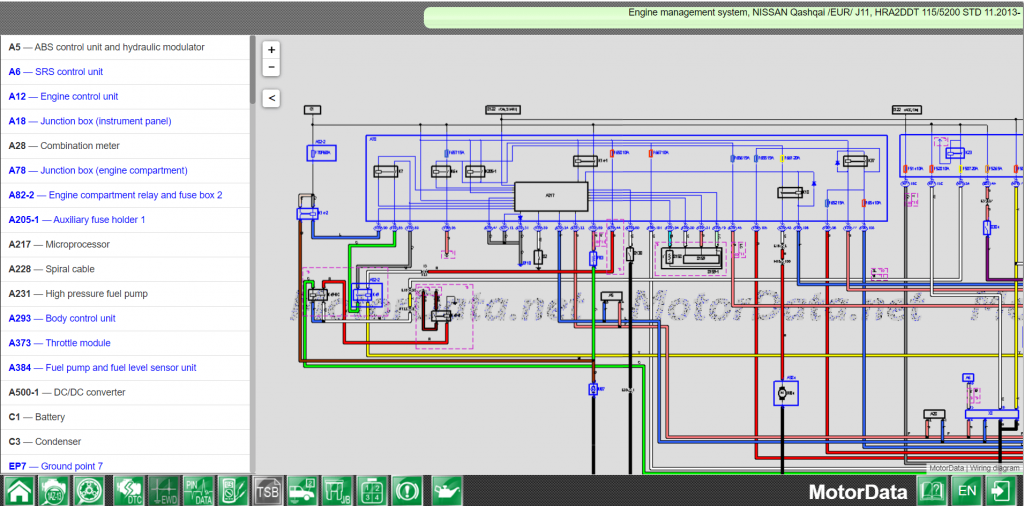
Wiring diagram — Engine Management System, NISSAN Qashqai
The engine management system is the foundation of any Nissan electrical diagnosis. The ECM (Engine Control Module) controls fuel injection, ignition timing, variable valve timing (CVTC and — on applicable engines — VVEL), idle speed, emission controls and communication with other vehicle systems over the CAN bus. Electrical faults here — a corroded MAF sensor connector, a broken CKP sensor wire or a poor ECM ground — account for a large share of check-engine complaints seen in repair shops worldwide.
MotorData provides interactive color wiring diagrams for the Nissan engine management system across all major models from 1995 onwards, including the QR20DE/QR25DE, VQ35DE/VQ40DE, MR20DE, HR16DE, HR12DE, K9K diesel and YD25DDTi engine families. Each diagram clearly shows the ECM connector pin layout, sensor circuits (MAF, MAP, ECT, O₂, CKP, CMP, knock), injector and ignition coil wiring, EVAP system, and all ground and shielding connections — fully color-coded and traceable with a single click.
Diagnosing P0101 (MAF sensor circuit), P0300 (random misfire), P0335 (crankshaft position sensor) or P0420 (catalyst efficiency) becomes far faster: click the suspect component in the diagram and instantly see its full circuit — power supply, signal wire, ground, connector pin numbers — cutting out the time normally lost to flipping through service manuals.

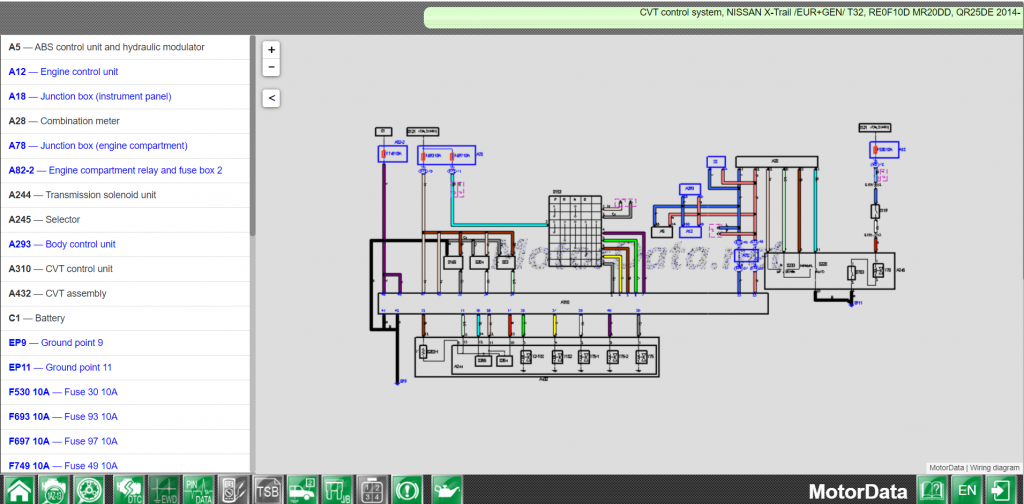
Wiring diagram — CVT Control System, NISSAN X-Trail
Nissan’s CVT (Continuously Variable Transmission) is one of the most widely used transmissions in the brand’s lineup and also one of the most frequently diagnosed in auto repair shops — especially the RE0F10A, RE0F10D, RE0F10E and RE0F11A units fitted to Qashqai, X-Trail, Altima, Tiida, Micra, Note and Murano. CVT electrical faults account for a significant share of transmission warning lights, harsh engagement and no-drive complaints.
The MotorData CVT wiring diagram shows the complete control circuit: from the TCM/CVT control unit through primary and secondary pulley speed sensors, line pressure control solenoid, secondary pressure solenoid, torque converter lockup solenoid, step motor, inhibitor switch (transmission range sensor) and CVT fluid temperature sensor — with all wire colors and connector pin numbers clearly identified.
This is essential for correctly diagnosing codes such as P0700 (transmission control system malfunction — request for MIL illumination from the TCM), P0705 (transmission range sensor circuit — faulty or misadjusted inhibitor switch), P0745 (line pressure control solenoid A — electrical fault), P0840 (transmission fluid pressure sensor/switch A circuit) and P0841 (pressure sensor circuit range / performance). These codes are extremely common on Nissan CVT vehicles aged 5+ years, and many are caused by a single corroded connector or broken wire in the CVT valve body harness — not by a mechanical failure requiring full transmission replacement.
Using the MotorData diagram, a technician can trace the line pressure solenoid circuit from pin to pin, check the TCM connector voltages and identify the exact fault location before ordering any parts.

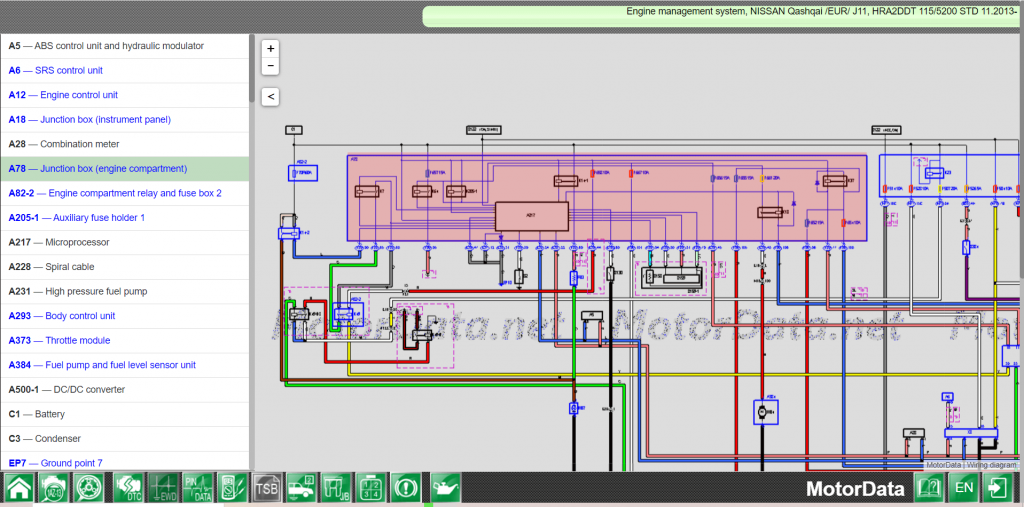
Wiring diagram — Junction Boxes, NISSAN Qashqai
The Nissan Qashqai is one of the best-selling compact crossovers in Europe and Australia, and its electrical systems are a frequent subject of workshop diagnostics — particularly CVT control faults, ABS/VDC sensor failures, EPS warning lights, CAN bus communication errors and push-button start no-crank complaints. MotorData covers interactive color wiring diagrams for the Qashqai J10 (2006–2013) and J11 (2013–2021) generations, for European and general market variants.
The J11 Qashqai is especially prone to CAN bus communication faults (U1000) — a code that simultaneously triggers ABS, SRS, EPS and NATS warning lights and can mislead a technician into replacing expensive modules. The MotorData diagram shows the exact CAN-H and CAN-L circuit routing, termination resistor locations (on Nissan typically integrated inside two specific ECUs — commonly the ECM and one bus endpoint module) and each control unit’s connector pins — making it possible to isolate a single corroded ground or chafed wire as the root cause in minutes.
Another high-frequency Qashqai J11 complaint is a brake light switch failure (P0571) that prevents the engine from starting with the Start button while brake lights still work. The stop lamp switch has two separate contacts — one for the brake lamps, one for the BCM/push-start logic — and only the second contact fails. The MotorData diagram makes this diagnosis immediate.
The Qashqai J10 is commonly seen with ABS wheel speed sensor circuit faults (C1101–C1108, depending on the affected wheel), often caused by corrosion in the underbody harness connector. The wiring diagram shows the exact four-wire circuit for each active sensor — power, ground, signal and shield — with connector pin numbers for direct voltage testing without disassembly.
Common Nissan Qashqai fault codes: P0745, P0840 (CVT solenoid / pressure sensor), P2101 / P2118 (ETC limp-home), P0571 (brake light switch), C1101–C1108 (ABS wheel speed sensor), U1000 (CAN communication), B2614 (Intelligent Key / NATS), P1212 (TCS communication line).

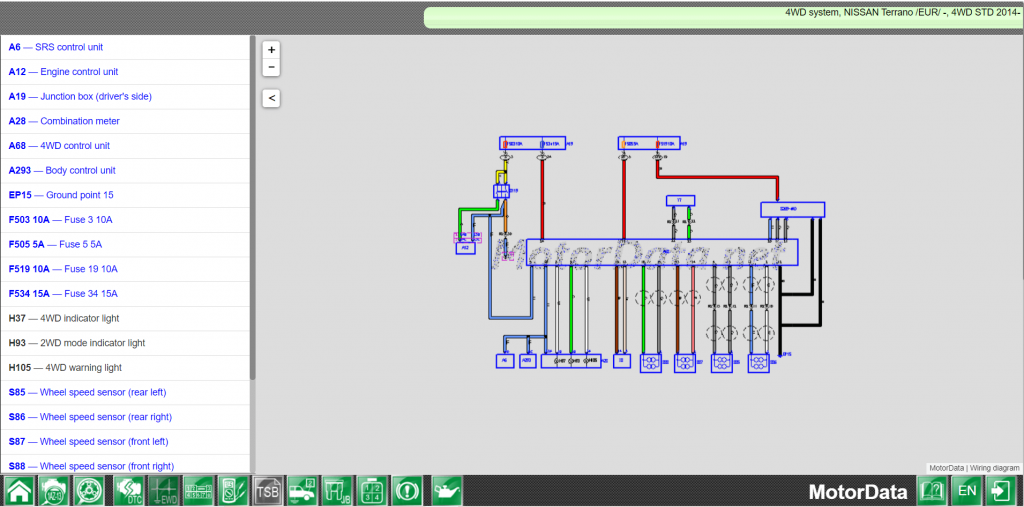
Wiring diagram — 4WD System, NISSAN X-Trail
The Nissan X-Trail is a globally popular SUV available with manual, automatic and CVT transmissions, and optional all-wheel drive across three generations — T30 (2000–2007), T31 (2007–2014) and T32 (2013–2022). Electrical faults in the X-Trail span a wide range: CVT control issues, 4WD system malfunctions, ABS sensor failures, EPS faults, IPDM-related no-starts and body electrical problems. MotorData covers all three generations with interactive color wiring diagrams for European, Japanese and general market specifications.
The electronically controlled AWD coupling on T31 and T32 is particularly prone to moisture ingress at the underbody connector — causing intermittent AWD warning lights without any mechanical failure. The MotorData diagram shows the complete actuator circuit: motor power supply, feedback sensor signal, AWD ECU control wire and ground path, with all pin numbers visible at a zoom level that makes on-vehicle diagnosis straightforward from a laptop in the workshop.
T32 X-Trail is also a frequent case for IPDM E/R-related no-start (no fuel pump prime heard when ignition is switched on) and cooling fan inoperative at idle — both trace back to internal IPDM relay contacts. MotorData IPDM diagrams show input triggers from the BCM over CAN, fuse allocation and output pins to each load, so the fault can be isolated before replacing the module.
Common Nissan X-Trail fault codes: P0745, P0840 (CVT), P2101 / P2118 (ETC limp-home), C1101–C1108 (ABS wheel speed sensors), C1201 (AWD/ABS control system malfunction), U1000 (CAN bus), B2614 (Intelligent Key), P1212 (TCS communication line), P0571 (brake switch — T32).

Wiring diagram — Anti-lock Brake System, NISSAN Sentra
The Nissan Sentra is one of the highest-volume compact sedans on the North American market and a frequent visitor to independent repair shops across the USA, Canada and Latin America. MotorData provides interactive color wiring diagrams for the Sentra B15 (2000–2006), B16 (2007–2012) and B17 (2013–2019) generations, covering the QG18DE, MR20DE, MRA8DE and QR25DE engine families, RE0F08A/RE0F11A CVT units, IPDM E/R, ABS, SRS, NATS and body electrical circuits.
The B17 Sentra is the subject of multiple TSBs covering the RE0F11A JATCO CVT — judder, slip and warning lights traced to valve body solenoid circuits and the transmission fluid pressure sensor. MotorData shows the complete TCM-to-valve-body harness, each solenoid pinout and the CVT fluid temperature sensor circuit, allowing precise testing of P0745 and P0840 without removing the transmission.
The Sentra is also a textbook case for IPDM E/R internal relay failure: no fuel pump prime, intermittent cooling fan operation and random no-starts on B16 and B17 models. The MotorData IPDM diagram shows BCM-to-IPDM CAN request lines, output pins to the fuel pump and cooling fan, and fuse allocation — letting the technician confirm whether the IPDM itself has failed or the fault lies downstream in the load circuit.
On the MR20DE and QR25DE engines, ETC limp-home events (P2101, P2118) and CKP hot-stall (P0335) are widespread. Both are diagnosable in minutes using the MotorData engine management circuit without guessing at the root cause.
Common Nissan Sentra fault codes: P0101 (MAF sensor), P0300 (random misfire), P0335 (CKP — hot-stall), P0420 (catalyst efficiency), P2101 / P2118 (ETC limp-home), P0700 (transmission control — request from TCM), P0745 (CVT line pressure solenoid), P0840 (CVT pressure sensor), P0571 (brake switch — B17), B2614 (NATS / Intelligent Key).
Buy now →

Wiring diagram — Body Electrical and CAN Bus, NISSAN Teana
The Nissan Teana is a mid-size to premium sedan built on the Nissan D platform and sold primarily across the CIS, Middle East, China and Southeast Asia markets — the close relative of the US-market Altima. MotorData provides interactive color wiring diagrams for the Teana J31 (2003–2008), J32 (2008–2013) and L33 (2014–2020) generations, covering the VQ23DE, VQ25DE, VQ35DE, MR20DE and QR25DE engines, RE0F09A and RE0F10 CVT units, IPDM E/R, ABS/VDC, SRS, Intelligent Key / NATS, BCM and full multi-bus CAN network.
The J32 and L33 Teana are particularly challenging to diagnose because of their sophisticated multi-bus CAN architecture — powertrain CAN, chassis CAN and body CAN linked through the BCM gateway function. A single corroded ground or a failing module can bring down an entire sub-bus and light up the dashboard with simultaneous warnings from ABS, VDC, SRS, EPS, HVAC and Intelligent Key. The MotorData diagram shows each CAN sub-bus separately, gateway pin assignments and termination resistor locations — critical for isolating U1000, U0100, U0101 and U0121 without replacing modules one by one.
Teana J32 is well-known in the field for BCM wake-up issues after battery replacement — the dashboard lights up with every warning possible, but a single blown fuse or wake-up line interruption is the real cause. MotorData’s BCM power/wake-up diagram shows every permanent, ignition-switched and accessory feed, along with all wake-up inputs from doors, tailgate and key antenna.
The Teana also uses the same RE0F09A / RE0F10 CVT family as Murano and Altima, with the same line pressure solenoid (P0745) and pressure sensor (P0840) failure patterns. On J32 and L33 with the Intelligent Key system, B2614 no-start conditions after battery replacement or aftermarket alarm installation are a classic workshop case — MotorData shows the complete Intelligent Key antenna network (inside and outside the cabin), BCM interface and the permission signal to the ECM.
Common Nissan Teana fault codes: U1000 (CAN communication), U0100 / U0101 / U0121 (lost communication with ECM / TCM / ABS — gateway issues), P0745, P0840 (CVT), P2101 (ETC), P0335 (CKP), C1101–C1108 (ABS wheel speed sensors), C1143 / C1144 (steering angle sensor), B2614 (Intelligent Key / NATS).

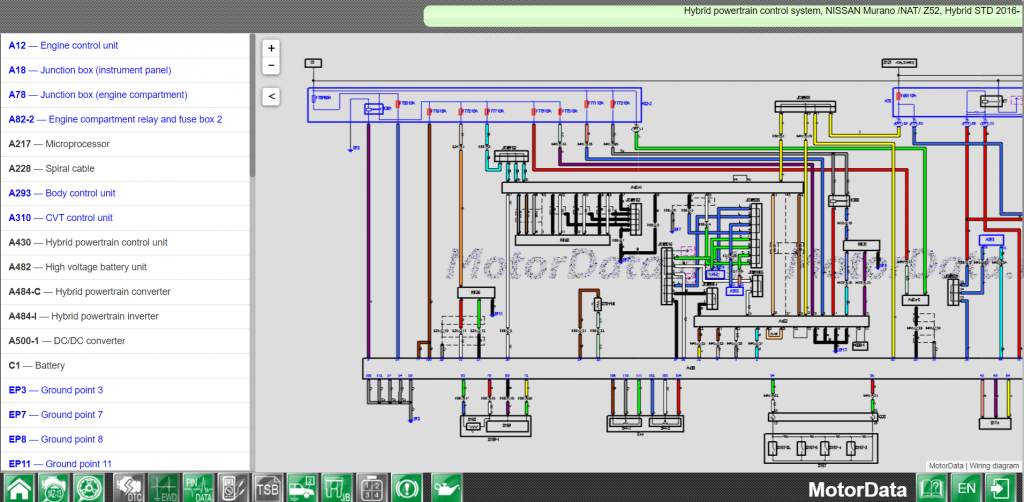
Wiring diagram — Data bus, NISSAN Murano
The Nissan Murano is a premium crossover with a sophisticated multi-bus CAN network integrating ECM, TCM, ABS/VDC, SRS, BCM, NATS, HVAC and instrument cluster modules. This architecture makes the Murano particularly challenging to diagnose when a single CAN bus fault triggers warning lights across multiple systems simultaneously. MotorData covers the Murano Z50 (2002–2008, USA/EUR/JAP), Z51 (2008–2015, USA/JAP) and Z52 (2015–2022, NAT) with interactive color wiring diagrams.
The most valuable feature for Murano diagnosis is the ability to trace the CAN-H and CAN-L wiring from the gateway through each node — ECM, TCM, ABS/VDC ECU, SRS ECU, BCM — and identify whether a U1000 code is caused by a broken wire, loss of bus termination (on Nissan the 120 Ω termination is typically integrated inside two specific ECUs; if one ECU is removed, bus impedance collapses) or a failing module pulling the bus low. The diagram shows full CAN bus topology together with each module’s connector pin assignment.
Z51 Murano is also commonly affected by BCM wake-up issues after battery replacement, presenting with multiple simultaneous warning lights that clear once the correct wake-up line is restored. The BCM power/wake-up diagram makes this a five-minute job.
Common Nissan Murano fault codes: U1000 (CAN communication line malfunction), P0745, P0840 (CVT), P2101 (ETC), C1101–C1108 (ABS wheel speed sensors), C1143/C1144 (steering angle sensor), B2614 (Intelligent Key / NATS), U1010 (CAN control module configuration).

Wiring diagram — Diesel Engine Control, NISSAN Navara
The Nissan Navara (sold as the Frontier in North America) is one of the world’s most widely used pickup trucks, working in commercial fleets, agricultural environments and off-road conditions that accelerate underbody harness corrosion and connector damage. MotorData provides interactive color wiring diagrams for the Navara/Frontier D40 (2005–2014, EUR/GEN) and NP300 / D23 (2014–2022, GEN) generations.
Diagram coverage includes the YD25DDTi 2.5L diesel engine management (common-rail fuel injection, EGR system, glow plugs, DPF where fitted), the VQ40DE 4.0L petrol management system, the part-time 4WD transfer system with electronic shift control, ABS and the body electrical network — including trailer towing circuits, a frequent source of faults on commercial vehicles.
The YD25DDTi engine is well known for EGR-related faults (P0401, P0402, P2458 depending on market calibration) caused by carbon-blocked EGR passages, but the same symptoms can also result from an electrical fault in the EGR solenoid or the EGR valve position sensor circuit. Precise circuit testing is required to distinguish one cause from the other. The MotorData diagram shows the full EGR control circuit for both vacuum-actuated and electrically-actuated EGR variants.
Common Nissan Navara/Frontier fault codes: P0401 / P0402 (EGR flow — YD25DDTi), P0420 (catalyst efficiency — VQ40DE), C1101–C1108 (ABS wheel speed sensors), C1201 (4WD/ABS control), P0500 (vehicle speed sensor), P0335 (CKP), glow plug circuit codes on YD25DDTi.

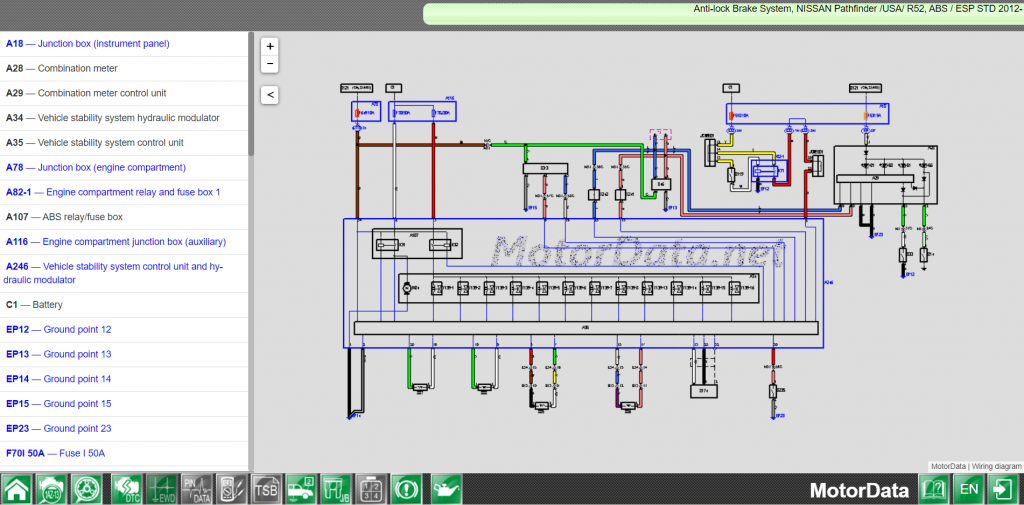
Wiring diagram — 4WD and Engine Control, NISSAN Pathfinder
The Nissan Pathfinder is a full-size SUV popular in the USA, Middle East and Australia. MotorData covers both main generations — the R51 (2004–2012, EUR+GEN) with the VQ40DE petrol and YD25DDTi diesel engines, and the R52 (2012–2021, USA) with the VQ35DE engine and CVT.
The R51 generation is well known in workshops for variable valve timing (VVT) faults on the VQ40DE engine — codes P0011 (intake camshaft position timing over-advanced, bank 1) and P0021 (bank 2) — often caused not by mechanical timing chain problems but by a faulty intake VTC control solenoid or its wiring circuit (sometimes reported by scan tool as P1011/P1021 on older software). The MotorData diagram lets the technician test the solenoid control circuit (duty-cycle signal, power supply and ground) before condemning the timing chain or solenoid.
The R52 Pathfinder is frequently seen with brake light switch P0571 / push-button start no-crank and ETC limp-home (P2101) — both diagnosable in minutes using MotorData circuits. The R51, meanwhile, is a classic for NATS no-start conditions after battery replacement or aftermarket accessory installation that disrupts the key antenna circuit.
Common Nissan Pathfinder fault codes: P0011, P0021 (intake VTC — bank 1/2), P0700 (CVT — R52), P0745 (CVT line pressure — R52), P2101 / P2118 (ETC — R52), P0571 (brake switch — R52), B2614 (Intelligent Key / NATS), C1201 (4WD control), P1212 (TCS communication line).

Wiring diagram — Body Electrical, NISSAN Micra
The Nissan Micra (sold as March in Japan) is a compact city car produced across multiple generations — K11 (1992–2002, EUR), K12 (2002–2010, EUR) and K13 (2010–2017, GEN) — and remains one of the most common vehicles in European workshops for basic electrical repairs. Despite its simplicity, Micra electrical faults can be surprisingly difficult to trace without a wiring diagram: the body electrical network, central locking, exterior lighting and EPS (where fitted) share ground points that can cause multi-system failures from a single corroded connection.
MotorData provides interactive color wiring diagrams for all three Micra generations, covering engine management (CG10DE, CG13DE, CR12DE/CR14DE, HR12DE), ABS on equipped variants, EPS, exterior lighting, central locking and body electrical circuits. The diagram for the K12/K13’s electric power steering is especially valuable: EPS warning lights are frequently caused by a torque sensor wiring fault or a poor EPS ECU ground — both are straightforward to diagnose using the MotorData circuit layout.
Common Nissan Micra fault codes: P0335 (CKP sensor), P0505 (idle control system), C1101–C1108 (ABS wheel speed sensors), EPS sensor circuit codes (depending on generation), U1000 (CAN bus — K13).

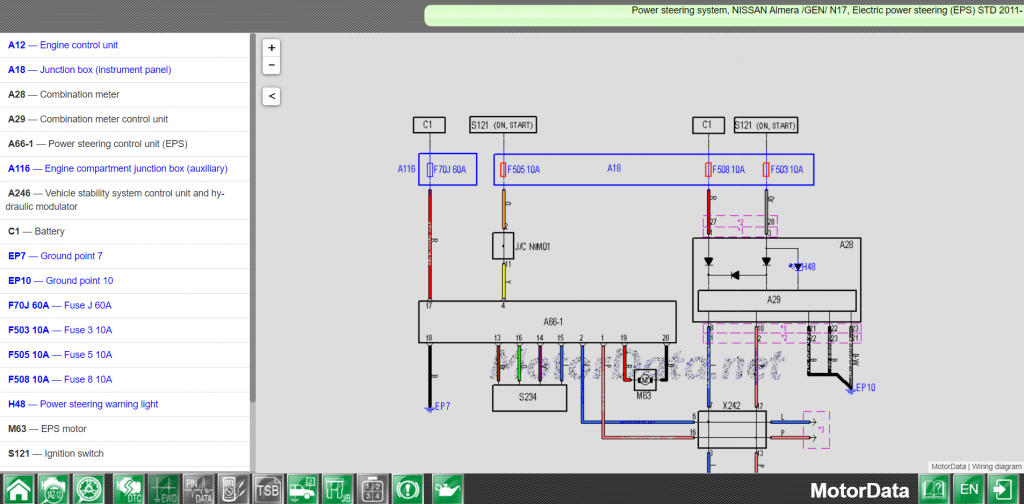
Wiring diagram — Engine management system, NISSAN Almera
The Nissan Almera spans three distinct generations and four market variants in the MotorData database: N15 EUR (1995–2000), N16 EUR (2000–2006), Almera Classic (B10 platform, rebadged Samsung SM3 / Renault, 2006–2013) and Almera G11/G15 (GEN/NAT, 2011–2021) — the latter sold in markets including Southeast Asia and Russia. Each generation has a distinct electrical architecture, so selecting the correct market variant in MotorData is essential.
The N16 Almera is a frequent workshop visitor with immobiliser faults and ignition system issues on the SR20DE, QG15DE and QG18DE engines. The Almera Classic often presents with body-electrical faults — a typical case is central locking that stops working because of a corroded BCM connector, which the MotorData diagram resolves by showing the exact pin and wire color for each door actuator circuit.
Common Nissan Almera fault codes: P0300 (random misfire — ignition system), P0335 (CKP sensor), P0505 (idle control), B2614 (immobiliser / NATS), C1101–C1108 (ABS wheel speed sensors — N16 / Classic).

Wiring diagram — Anti-lock Brake System, NISSAN Primera
The Nissan Primera — P11 (1996–2002, EUR) and P12 (2002–2007, EUR) — is an older but still frequently serviced model in European workshops, particularly in Eastern Europe, the UK and the Middle East. The P12 generation features a relatively complex CAN bus network for its era, and its ABS/TCS system is a common source of fault codes caused by wheel speed sensor harness damage from road debris.
MotorData provides interactive color wiring diagrams for both Primera generations, covering engine management (SR20DE/VE, QG18DE, QR20DE, QR25DE and YD22DDTi diesel), automatic transmission (RE4F04B), ABS, exterior lighting and body electrical. The YD22DDTi diesel on the P12 is particularly prone to EGR valve circuit faults, where the wiring diagram is essential to distinguish between a mechanical EGR restriction and an electrical solenoid control circuit issue.
Common Nissan Primera fault codes: P0401 / P0402 (EGR flow — YD22DDTi), P0335 (CKP), P0725 (engine speed input — AT), ABS wheel speed sensor circuits, U1000 (CAN bus — P12).

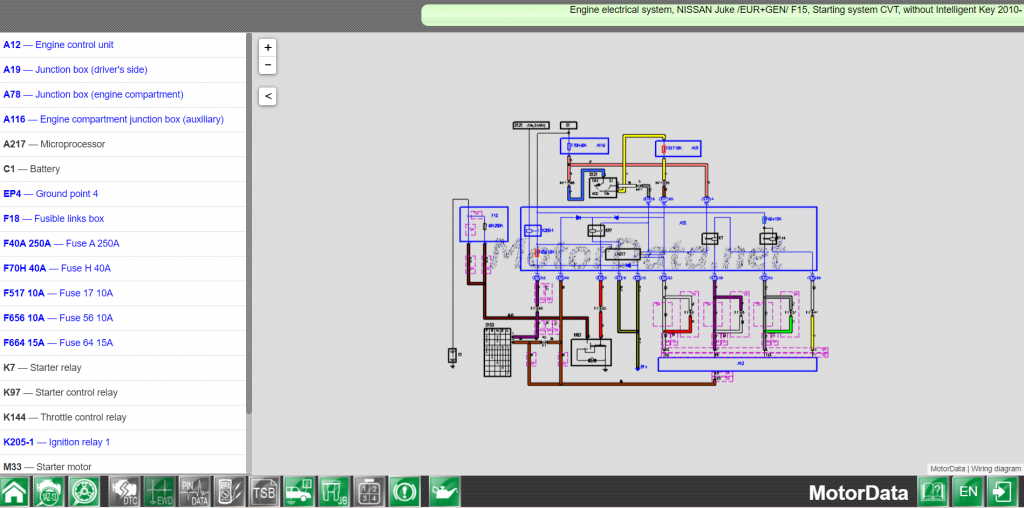
Wiring diagram — CVT control system, NISSAN Note / Juke
The Nissan Note (E11 EUR 2006–2013, E12 EUR 2013–2017) and Nissan Juke (F15, 2010–2019) are compact hatchbacks and crossovers sharing many electrical components — the HR16DE engine, CVT and body electrical network. Both are frequent visitors in European workshops for CVT fault codes, EPS warning lights, ETC limp-home events and NATS no-start conditions following battery replacement.
The Juke F15 in particular has a documented history of EPS column electrical failures, many covered by extended warranty campaigns. Before condemning the EPS column, the MotorData wiring diagram allows verification of EPS power supply, ground integrity, CAN communication to ABS/ECM and the torque/angle sensor signal — a meaningful share of “EPS fault” complaints turn out to be a blown fuse, a bad ground or lost calibration after a battery voltage dip, rather than a failed motor.
The Note E12 with CVT is also commonly seen with P0745 and P0840 codes — typically caused by deterioration of the CVT fluid temperature sensor circuit or the line pressure solenoid harness connector after 60,000–80,000 km. Both the Note E12 and Juke F15 use the LIN-controlled alternator system, so unexplained battery undercharging should be diagnosed with the alternator control wiring diagram, not just by bench-testing the unit.
Common Nissan Note / Juke fault codes: P0745, P0840 (CVT), P2101 (ETC), P0562 / P1550–P1554 (charging system — LIN alternator), EPS torque/angle sensor circuit codes, B2614 (NATS / Intelligent Key), U1000 (CAN bus).

MotorData Professional significantly simplifies the work of auto electricians and diagnostic technicians. The platform’s key features include colored wires matching actual vehicle harness colors, cross-references to related circuits and modules, scaling from full-system overview down to individual connector pin level, quick element search, and bright wire tracing — selecting a wire highlights it across the entire circuit instantly.
The software contains more than 20,000 interactive electrical diagrams for vehicles from Japan, Korea, China and other regions, plus over 60,000 interactive diagnostic codes (DTC), 4,500+ ECU pinouts (Pin Data), service bulletins (TSB), component location diagrams, fuse and relay box data and reference waveforms — all cross-linked within a single platform.
MotorData is cloud-based and runs in any modern browser on Windows, macOS, tablets and smartphones. For workshop use, a laptop or tablet is recommended for comfortable diagram viewing. No installation, no updates to manage — just sign in and start diagnosing.
Nissan wiring diagrams are schematic representations of the electrical connections and wire circuits in a vehicle. They help auto electricians locate and eliminate faults by showing exactly which wire goes where, what color it is, which connector pin it terminates at, and how the circuit connects to its power source, ground and control module.
A typical modern Nissan electrical circuit — like the on-board network of any current Nissan — consists of four fundamental parts: power sources (battery positive and alternator output); electronic control units, fuses and relays for circuit monitoring and protection against overload and short circuits; energy consumers (fuel and ignition systems, engine management, CVT/automatic transmission, ABS, EPS, body electrical, lighting and signalling); and electrical wiring, connectors and ground points — the return path to the battery negative.
What makes MotorData diagrams uniquely effective is the combination of wire colour accuracy (each wire is drawn in the same colour as in the actual vehicle harness), interactivity (click to highlight and trace), scale flexibility (zoom from system overview to individual pin level) and cross-referencing (every diagram links directly to DTC codes, ECU pinouts and component location diagrams for the same model). Together these features can turn a lengthy paper-schematic trace into a focused on-screen diagnosis taking a fraction of the time.
MotorData Professional provides online access to interactive color wiring diagrams for Nissan vehicles — Qashqai, X-Trail, Teana, Sentra, Murano, Navara, Pathfinder, Micra, Almera, Note, Juke, Tiida, Primera and 170+ models from 1986 to 2022. Cloud-based, runs in a browser, no installation required.
The most frequent Nissan electrical issues where a wiring diagram is essential include: Electronic Throttle Control limp-home (P2101, P2118); IPDM E/R internal relay failures (no fuel pump prime, cooling fan inoperative, no-start); CVT circuits (P0745, P0840); CKP sensor hot-stall (P0335); brake light switch failure blocking push-button start (P0571); LIN-controlled alternator issues (P0562, P1550–P1554); O₂/AFR heater circuits (P0031, P0037, P0135, P0141); CAN/gateway faults (U1000 plus U0100 family); NATS / Intelligent Key no-start (B2614); and BCM wake-up / power-feed problems after battery replacement.
Yes. MotorData covers Nissan CVT wiring diagrams for RE0F08A, RE0F09A, RE0F10A, RE0F10D, RE0F10E, RE0F11A and other CVT units fitted to Qashqai, X-Trail, Teana, Sentra, Tiida, Murano, Note and Micra — including the TCM/CVT control circuit, primary and secondary pulley speed sensors, line pressure solenoid (P0745), transmission fluid pressure sensor (P0840, P0841) and inhibitor switch circuit (P0705).
Yes. MotorData provides full multi-bus CAN wiring diagrams for Nissan models with split powertrain, chassis and body CAN networks — including Teana J32/L33, Murano Z51/Z52, Qashqai J11 and X-Trail T32. Each sub-bus is shown separately with gateway pin assignments, termination resistor locations and module-level connector pinouts — essential for isolating U1000, U0100, U0101 and U0121 codes without replacing modules one by one.
U1000 is the Nissan CAN communication line malfunction code, triggered when one or more modules lose communication on the CAN bus. It frequently appears alongside ABS, SRS, EPS and NATS codes simultaneously, and on newer multi-bus Nissans (Qashqai J11, X-Trail T32, Teana J32/L33) together with U0100, U0101 and U0121 when the gateway stops passing messages between sub-buses. The MotorData wiring diagram shows the complete CAN-H and CAN-L topology for each Nissan model — including bus termination locations (typically integrated inside two specific ECUs), gateway connections and each module's CAN connector pin numbers — making it possible to isolate a single broken wire, dead sub-bus or bad ground as the root cause.
That is the Electronic Throttle Control (ETC) fail-safe mode, typically accompanied by P2101, P2118, P1225 or P1229 on QR25DE, MR20DE, HR16DE and VQ35DE engines used in Sentra, Teana, Qashqai, X-Trail and Murano. While the throttle body itself can fail, the real cause in many workshop cases is the ETC motor relay inside the IPDM E/R, a broken TP sensor wire or a poor ECM ground. The MotorData diagram shows the full ETC circuit including IPDM relay allocation — essential before replacing the throttle assembly.
Yes. MotorData covers the NATS and Intelligent Key immobiliser wiring for multiple Nissan models and generations — including Teana J31/J32/L33, Sentra B16/B17, Qashqai, X-Trail, Murano and Pathfinder — with the key transponder antenna circuit, NATS ECU / BCM NATS function, the permission signal to the ECM and the NATS indicator light circuit. This is essential for diagnosing B2614 and no-start conditions related to NATS after battery replacement or key reprogramming.
Yes. MotorData Professional is a cloud-based platform running in a browser on Windows, macOS, tablets and smartphones. For workshop use, a laptop or tablet is recommended for comfortable diagram viewing and zooming. No installation or updates required — sign in and start working.
MotorData specialises in Japanese, Korean and Chinese vehicles, giving it significantly deeper Nissan and Infiniti coverage compared to US-focused general repair databases — including models rarely covered elsewhere such as Teana (J31/J32/L33), Tiida, Almera Classic and Mistral/Terrano. MotorData combines wiring diagrams, 60,000+ DTC codes, 4,500+ ECU pinouts, TSB bulletins, component location diagrams and fuse/relay data in one platform with direct cross-links between all data types — eliminating the need to switch between separate tools during a diagnostic session.
Yes. MotorData Professional offers a free trial — no credit card required. Test Nissan wiring diagrams, DTC codes and all platform features before choosing a subscription plan. Start free trial →
Nissan wiring diagrams are one part of the MotorData diagnostic platform. The same interactive, color-coded approach applies to all brands and vehicle systems in the database:
— Interactive Color Wiring Diagrams for Toyota → — Camry, RAV4, Corolla, Prius, Land Cruiser and 100+ models
— Interactive Color Wiring Diagrams for Mitsubishi → — Outlander, Lancer, Pajero, Eclipse Cross and more
— Diagnostic Software for Nissan — Full Overview → — ECM, CVT, ABS, NATS, SRS, BCM, Intelligent Key and more
— Full Nissan Model Catalog in MotorData → — 170+ models with data availability details
— Auto Electrician Software with Wiring Diagrams → — how MotorData works as a complete professional platform
| Cookie | Duration | Description |
|---|---|---|
| cookielawinfo-checkbox-analytics | 11 months | This cookie is set by GDPR Cookie Consent plugin. The cookie is used to store the user consent for the cookies in the category "Analytics". |
| cookielawinfo-checkbox-functional | 11 months | The cookie is set by GDPR cookie consent to record the user consent for the cookies in the category "Functional". |
| cookielawinfo-checkbox-necessary | This cookie is set by GDPR Cookie Consent plugin. The cookies is used to store the user consent for the cookies in the category "Necessary". | |
| cookielawinfo-checkbox-others | 11 months | This cookie is set by GDPR Cookie Consent plugin. The cookie is used to store the user consent for the cookies in the category "Other. |
| cookielawinfo-checkbox-performance | 11 months | This cookie is set by GDPR Cookie Consent plugin. The cookie is used to store the user consent for the cookies in the category "Performance". |
| viewed_cookie_policy | 11 months | The cookie is set by the GDPR Cookie Consent plugin and is used to store whether or not user has consented to the use of cookies. It does not store any personal data. |